Tuesday, March 29, 2016

VIOLET

There is a lady in housekeeping named Violet. She's from the Philippines. She doesn't speak English very well. She doesn't always understand me. She tries very hard to do what I ask. She has a good heart.

I had some chocolate truffles. I offered Violet one. She was so appreciative. The other day I got a sandwich for lunch. I decided not to eat it. I saved it for Violet. I knew she needed it more than I did She is alone in this country. Violet works hard. I knew she would appreciate the sandwich. She did. She told me she loved me. She said when she went back to her country that she would always remember me.

I cannot imagine coming to a new country. I cannot imagine being all alone in that country. That takes tremendous strength and courage.  Strength and courage I know I do not have.

We are not really supposed to give things to the staff. I don't want to cause any trouble for Violet. But, if you can help someone by doing even the simplest thing, like saving a sandwich for them, I think it is okay to break the rules once in a while.

I realize how lucky I am. The experience made me appreciate my family more. I am grateful for what I have. Whatever I want or need my family gets for me. Many people are not as fortunate. 

I will always remember you too Violet.


Sunday, March 27, 2016

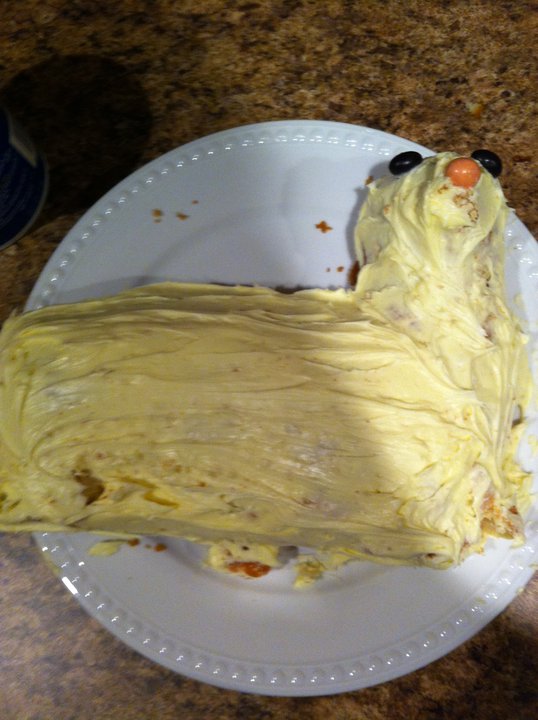
THE SAGA OF THE EASTER LAMB

I have many Easter memories. Getting all dressed up to attend the continental breakfast at church. The breakfast was followed by a worship service filled with music celebrating Christ's resurrection.

I remember my hands being every color of the rainbow after all the eggs had been dyed.

The Easter Bunny didn't only leave baskets at my house, he left them at my grandparent's house too. How lucky were we? 

My strongest and most vivid Easter memory is watching my mother bake and decorate lamb cakes. 

Making the lamb cakes was a two-day process. The first day she baked them. The cake itself was a rich pound cake that was made from scratch.  The recipe made two. lambs. She made a double batch. 

The cast iron lamb mold was given to my grandfather. it is well over one hundred years old. The lamb cakes would bake to a golden brown. The biggest challenge was getting them out of the mold without an ear breaking off. For most years,  at least one ear was held together by a toothpick.

The second day was reserved for icing and decorating them. The icing on the face was made from powdered sugar. The eyes, nose, and mouth were jelly beans/ The body was iced with thick white frosting,. The final step was putting the coconut on to represent the lamb's wool. 

A lamb was sent to the out-of-town family. In this case, she would start a few days ahead of Easter to ensure that the lamb reached its destination on time. 

There was always an extra lamb that would be given to friends with small children. The children did not always eat the cake, but they looked at that cake as though they couldn't believe what they were seeing.

I am not a fan of coconut. I don't how this happened but one year she put chocolate icing on one of the lambs without any coconut. It was delicious. We christened the chocolate-iced lamb the Black Sheep of the family.

The tradition of making lamb cakes was passed from my grandmother to my mother. It was important to me that this tradition not end with the death of my mother. 

If I were at home and my mom was still alive, a lamb cake would be the centerpiece of our Easter table. My niece has the mold now. I am happy that she has made lamb cakes for her family. A lamb is the centerpiece of her Easter table now. The tradition continues


Photos Courtesy of Brooke Grana Darnell


Thursday, March 24, 2016

WEAR GREEN FOR ERIN AND ME


Several weeks ago,  I read a story online, about a young woman with CP. Her name is Erin Feeney. 


Erin is a twenty-four-year-old college student. More importantly, Erin is the author of the book Kids in Toyland.  Her book is a collection of short stories that have an anti-bullying message. The idea for the book came from Erin's experiences of being bullied in school. She published it when she was sixteen years old. Her stories were turned into a short film. Earlier this month, the film was given a red carpet premiere at a theater in Erin's hometown of Naperville, Illinois. I  almost forgot to mention that Erin is unable to speak. She uses a computer and letter board to communicate. I forgot because that's not what's important. What's important is what she has to say. 

Erin and I began emailing each other after I read her story. I wanted to congratulate her on her success. I always enjoy talking with fellow writers. 

Erin is writing a novel. After college, she hopes to write for Disney. I have no doubt she will succeed.

March 25h is a day to show support for people with Cerebral Palsy. Wear green to raise awareness. Wear green to show that you see us as people first. Wear green to show that you believe in us. Wear green. It's my favorite color.

Erin Feeney's book is available on iTunes 


Tuesday, March 8, 2016

THE BRAIN'S WHERE IT'S AT

Chris Style-Campion is the Speech and Language Pathologist here. I always thought someone who worked in speech and language assisted a person who had difficulty speaking. After talking to Chris, I discovered there is much more involved in her job the just helping someone improve their speech.

Chris always had an interest in the medical field but was not interested in becoming a physician. After working in several offices that offered physical therapy, occupational therapy, and speech therapy, Chris decided to pursue a career in Speech and Language Pathology.

Chris received her masters from the University of Maryland. She worked in her first job for three years. Chris has worked at this facility for three years. Before coming here she worked at another campus of this facility for six years

Much of the work Chris does involves helping residents who have Dysphagia. This condition is more commonly referred to as difficulty swallowing. Chris works with the dietitian to make changes in a resident's diet to help alleviate the issue.

Chris helps residents who have cognitive or memory difficulties following a stroke. If a person is experiencing difficulty speaking there are exercises to help. There are also exercises for someone whose tongue and lips might not be working properly,

Chris works with people who have voice disorders. If someone speaks too softly, Chris has them do breathing exercises. This helps them learn to use the muscles in their diaphragm. This gives them the ability to speak louder.

I don't see Chris professionally. I see her walking around carrying her laptop That's how she charts her patients. We talk almost every day. She makes me laugh.

Chris makes sure all the residents she sees can eat comfortably without incident. She always. checks on them.

Chris helps the brain get the messages it needs to enable a person to swallow without choking. To think more clearly. To speak more distinctly.

When it comes to speech and language the brain's where it's at./.


Friday, March 4, 2016

SHE'S NEVER BORED

One of the first people that I met here was the staff dietitian, Julie Boyer.  

I didn't really know what a dietitian did, so I decided to interview her find out a little more about Julie and her duties here.
Julie has always felt a connection with the elderly. She knew she wanted to work with them. Not long after receiving her master's degree in nutrition and dialectics, from Missouri State University, she got the job here. She has been at this facility for two years. 
When a resident is admitted Julie does a nutritional assessment on them. This involves determining if a resident has any difficulty chewing or swallowing. They may have difficulty eating because they have dentures.  The findings of the assessment let Julie know if a change in a resident's diet will make eating easier for them. She asks food preferences too. 

Julie keeps track of the weight of all the residents. If a resident gains or loses weight too quickly, their weight is monitored more closely. If a resident has a feeding tube she monitors the feeding tube and makes nutritional suggestions. .The aides and nurses keep her informed.

If a resident has Alzheimer's Disease, they may become distracted during meals. In this case, Julie suggests redirecting them back to the meal through encouragement. If they are still not eating, she .suggests giving snacks or a dietary supplement.

Julie meets with dietitians from other facilities. The regional dietitian visits regularly to see how things are going.

Julie serves in the dining room. There are six dining rooms here. Julie used to have to oversee all of them. Now, that job has been given to someone else. Julie can devote her time to all of her other duties.

She is always available to residents. Just to talk or to listen to any concerns .regarding food.

Julie is always busy. Never bored. She wouldn't have it any other way.


Thursday, February 25, 2016

FOOD, GLORIOUS FOOD

I have always watched my weight. I wanted to make it easier for anyone assisting me.

My mom never denied me anything, but she did limit my desserts. She could not have taken care of me, by herself, until the age of eighty-seven if she hadn't.

The stress of my mother's illness and death caused me to lose a lot of weight. 

If a caregiver told me I was heavy, I  would try to lose weight.  I knew the caregiver did not mean that I was fat. She meant that I was heavy because I was unable to assist them when they were transferring me. I kept my weight down hoping it would make things easier for them.

I try to eat healthily. A lot of fruit and salads. I love yogurt too.  I have gained some weight. However, I am still a little underweight for my height. I  am a small person. They tell me I am doing okay.

When I got here,  I would notice what other residents were eating.  I would wonder how they could eat all the carbs and desserts that they did. Didn't they care about eating healthy? I am embarrassed to .admit I was judgmental. I was also a hypocrite.

It's not easy living in a facility. It can an extremely frustrating and stressful place. Some days, eating may be the only thing a resident has to look forward to. Food is a constant, food brings comfort. Food may be the only source of comfort some residents have.

I love junk food. I love desserts. There are days when I am so frustrated here that all of my thoughts of healthy eating go out the window. On those days I eat ice cream and whatever I want because I know ice cream and other desserts will make me feel better.

It's not easy for someone with a disability to keep their weight under control. No one knows that better than I do.

Everyone chooses the way they want to eat. Some days I eat healthily., some days I don't, Either way, it's okay.

Gotta go. It's almost time for ice cream!


Thursday, February 11, 2016

disAbility

I saw this quote on actor RJ Mitte's Facebook page. I knew I had to write a post about it.

 "A disAbility isn't a weakness, it's knowledge and strength."RJ Mitte'

There are still people who view a person with a disability as someone who is to be pitied, someone who cannot contribute. Someone inferior. The reality is that people with disabilities lead perfectly normal lives, yet we have to work twice as hard to be accepted. The world we live in is not made for people with disabilities. We encounter obstacles every day. They range from physical barriers to the attitudes of people who judge us solely because of our disability. They judge us based on what they see, rather than trying to get to know the person we are.  In my opinion, they are the weak ones.  

We know about perseverance because of the rejection we have encountered. I read about a young man with Cerebral Palsy who was rejected approximately one hundred times before he finally got a job. I cannot imagine what strength and courage it took for him to continue to apply for jobs. He persevered until he finally got the job he deserved. I was told I'd never get a job, but I was determined. I succeeded by creating a position for myself. 

We know about responsibility. When I taught computer classes I was responsible for getting a substitute to teach my classes if I was ill. If I did not get a sub, I  had to find time to make up the classes. I rarely missed class. I was only late once in sixteen years. I knew that my students deserved to get what they paid for. I did everything I could to make sure they had a positive experience in my class. 

We know about empathyPeople with disabilities can empathize with the difficulties others face. We face challenges every day. Everyone's challenges are different, if we can put ourselves in another person's shoes and think about how we would feel, in their situation, then we can understand. everyone needs to be empathetic toward each other. Not judgemental. No one knows the challenges another person may be dealing with.

We know patience. People with disabilities have learned that tasks may not be completed on their timetable. Patience is necessary when you depend on other people to assist you in your life

We know about gratitude. When you have a disability and need assistance you are grateful for things most people take for granted. I am grateful when someone answers my call light in a short amount of time. I am grateful that there is someone to get me out of bed, help me to the bathroom, and help me dress for the day. I take nothing for granted. I say thank you all the time.

The word disability has the word ability in it. Don't get stuck only seeing a person's disability. Don't focus on what they can't do. See them as a person. Focus on what they can do. 

There are days when I am tired.  Tired of making sure that my needs are met.  Tired of waiting. I have no choice but to keep going. People with disabilities are strong because of their disabilities. We face challenges. We persevere.  


.